

New Rates Adopted - Effective July 1, 2026
A public hearing was held on June 1, 2026 to hear all oral testimony and consider all written protests concerning the proposed rate increases. No valid legal objections nor written protests were received by the District prior to the close of the public hearing. After the close of the public hearing, the District governing board adopted Ordinance No. 96 establishing revised service charges. Below is the adopted Ordinance No. 96.

THE BASIS OF THE NEW SEWER SERVICE CHARGES
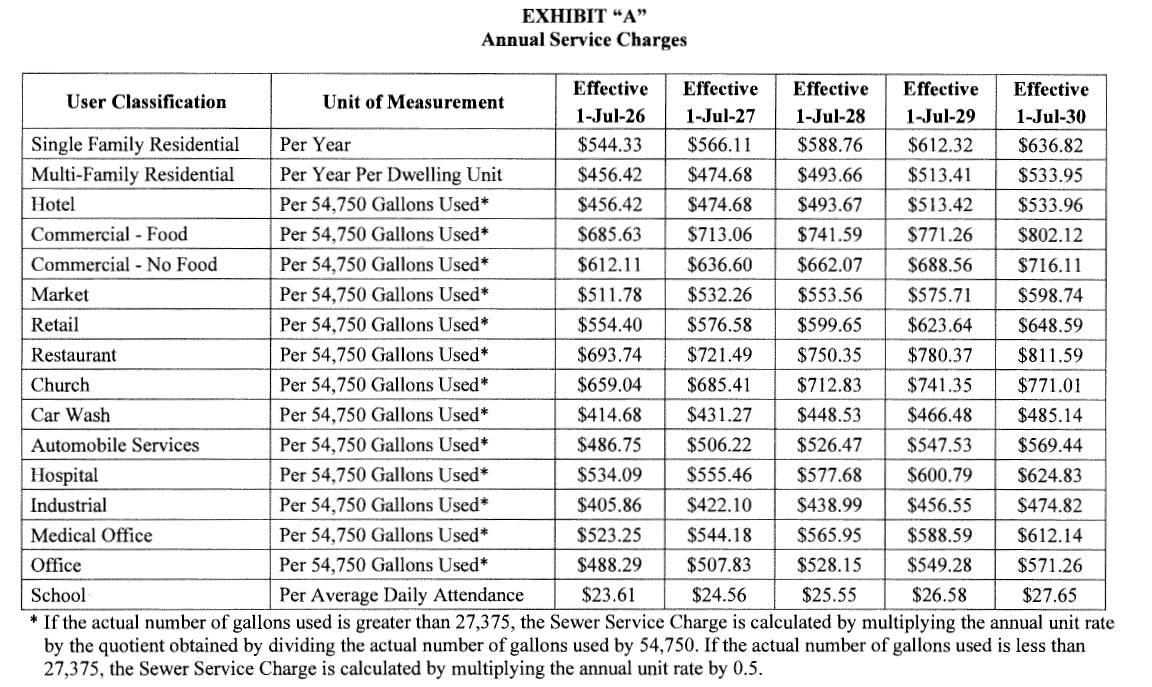
The District imposes sewer service charges through four customer classes: (1) single family residential (“SFR”), (2) multi-family residential (“MFR”), (3) schools, and (4) commercial customers. SFR and MFR customer classes pay a fixed annual charge per unit. MFR customers are billed per the number of dwelling units on the parcel. Schools are billed based on the average daily attendance (“ADA”). Finally, commercial customer classes are charged per equivalent residential unit (“ERU”). An ERU is based on the flow generation and estimated strength of the wastewater relative to the SFR customer class, therefore one ERU is equivalent to one SFR. The flow per ERU is defined as 150 gallons per day (“gpd”) and strength of 387 and 476 mg/L respectively for BOD and TSS.* Commercial customers are assigned rates based upon each customer’s flow generation (e.g., the amount of water use for the parcel) and estimated strength of the wastewater discharged into the system based on the type of commercial use. Commercial customers will be charged for no less than 75 gpd at their applicable rate, regardless of water use. The District proposes to continue including sewer service charges on the annual property tax rolls. The following table shows the maximum sewer service charges for all customer classes to be adopted for the next five fiscal years. *BOD is the biochemical oxygen demand and TSS is the total suspended solids associated with determining the strength of the wastewater prior to treatment.
Table of new Annual Service Charges Effective July 1, 2026
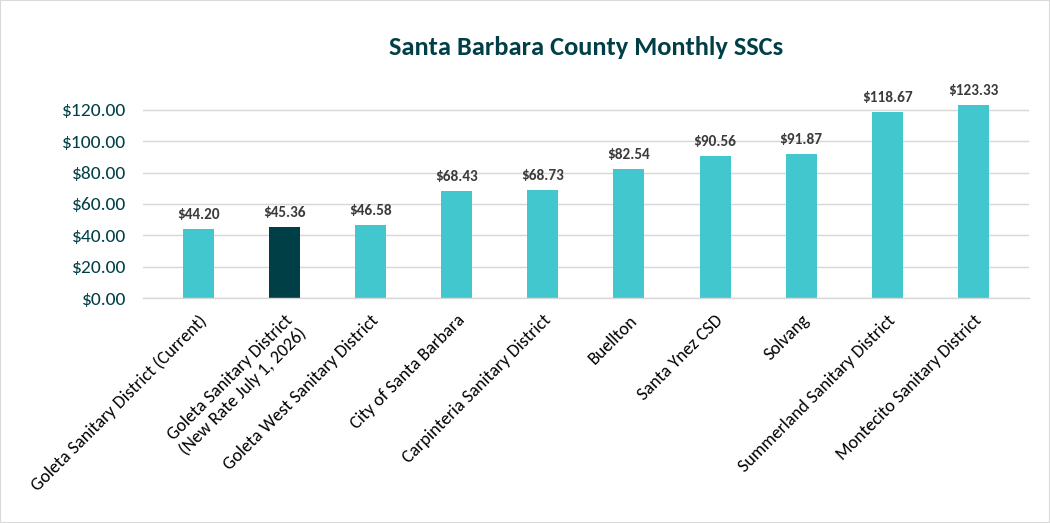
GSD's new rates are still below the others!
The new rates are needed to keep revenues aligned with long-term funding needs, including:
- Funding $73.4 million in treatment plant and collection system capital improvement projects over the next ten years, including vital infrastructure projects such as the biosolids and energy project, an energy storage project which reduces long-term costs of purchased power, a biosolids handling improvement project, increased biogas utilization project, and other long-term annual repair and replacement capital projects of approximately $3 million per year;
- Funding inflationary increases in operating and maintenance costs, including, but not limited to, price increases of power, chemicals, specialized services and equipment, construction, staffing, and other costs; and
- Funding the ongoing annual operations and maintenance costs, debt service obligations, and reserve funding ensuring financial and operational stability now and in the future.
Background Information
The Goleta Sanitary District (GSD) collects fees from different kinds of users: residents, agencies, and businesses in our service area to cover the costs of collecting, treating and reusing resources from wastewater. These fees are used to pay for ongoing maintenance and repairs to our existing facilities and equipment, and to pay for improvements. Over the last several years, the GSD has implemented a number of innovative cost-saving measures to keep rates low. Unfortunately, costs are outpacing revenues, and the new adjustments to our rates are needed.
We are mandated by law to charge only the amount required to provide services. Prior to this year the District last changed sewer rates in 2019, so an updated rate and fee study was commissioned in spring 2025. We hired a local firm to collect data to ensure that the different types of users are charged an amount equivalent to their usage. The rate study results are the basis for the change in fees to be charged, with some adjustments occuring to ensure fairness and equitablility. Rate adjustments help fund our operations which include: maintenance and repair of sewer pipes, the treatment plant, and planning for the future reliability of infrastructure. Below is the Rate and Fee Study.
Nuevas tarifas adoptadas — vigentes a partir del 1 de julio de 2026
Se celebró una audiencia pública el 1 de junio de 2026 para escuchar todos los testimonios orales y considerar todas las protestas escritas relacionadas con los aumentos de tarifas propuestos. El Distrito no recibió objeciones legales válidas ni protestas escritas antes del cierre de la audiencia pública. Después del cierre de la audiencia pública, la junta directiva del Distrito adoptó la Ordenanza Núm. 96, que establece cargos de servicio revisados. A continuación se presenta la Ordenanza 96 adoptada.
LA BASE DE LOS NUEVOS CARGOS POR SERVICIO DE ALCANTARILLADO
El Distrito impone cargos por servicio de alcantarillado a través de cuatro clases de clientes: (1) residencial unifamiliar (“SFR”, por sus siglas en inglés), (2) residencial multifamiliar (“MFR”, por sus siglas en inglés), (3) escuelas y (4) clientes comerciales. Las clases de clientes SFR y MFR pagan un cargo anual fijo por unidad. A los clientes MFR se les factura según el número de unidades de vivienda en la parcela. A las escuelas se les factura con base en la asistencia diaria promedio (“ADA”, por sus siglas en inglés). Finalmente, a las clases de clientes comerciales se les cobra por unidad residencial equivalente (“ERU”, por sus siglas en inglés).
Una ERU se basa en la generación de flujo y la concentración estimada de las aguas residuales en relación con la clase de clientes SFR; por lo tanto, una ERU equivale a una SFR. El flujo por ERU se define como 150 galones por día (“gpd”, por sus siglas en inglés), y la concentración se define como 387 y 476 mg/L, respectivamente, para DBO y SST.* A los clientes comerciales se les asignan tarifas con base en la generación de flujo de cada cliente, por ejemplo, la cantidad de uso de agua de la parcela, y la concentración estimada de las aguas residuales descargadas al sistema según el tipo de uso comercial.
A los clientes comerciales se les cobrará por no menos de 75 gpd a la tarifa aplicable, independientemente del uso de agua. El Distrito propone continuar incluyendo los cargos por servicio de alcantarillado en las listas anuales del impuesto predial. La siguiente tabla muestra los cargos máximos por servicio de alcantarillado para todas las clases de clientes que se adoptarán para los próximos cinco años fiscales.
*DBO significa demanda bioquímica de oxígeno y SST significa sólidos suspendidos totales, los cuales se utilizan para determinar la concentración de las aguas residuales antes del tratamiento.
Tabla de nuevos cargos anuales por servicio vigentes a partir del 1 de julio de 2026
¡Las nuevas tarifas de GSD siguen estando por debajo de las demás!
Las nuevas tarifas son necesarias para mantener los ingresos alineados con las necesidades de financiamiento a largo plazo, incluyendo:
- Financiar $73.4 millones en proyectos de mejoras capitales de la planta de tratamiento y del sistema de recolección durante los próximos diez años, incluyendo proyectos de infraestructura esenciales, tales como el proyecto de biosólidos y energía, un proyecto de almacenamiento de energía que reduce los costos a largo plazo de la energía comprada, un proyecto de mejoras en el manejo de biosólidos, un proyecto para aumentar el uso de biogás y otros proyectos anuales de reparación y reemplazo de capital a largo plazo de aproximadamente $3 millones por año;
- Financiar los aumentos inflacionarios en los costos de operación y mantenimiento, incluyendo, entre otros, aumentos en los precios de energía, productos químicos, servicios y equipos especializados, construcción, personal y otros costos; y
- Financiar los costos anuales continuos de operación y mantenimiento, las obligaciones del servicio de deuda y el financiamiento de reservas, asegurando la estabilidad financiera y operativa ahora y en el futuro.
Información de Antecedentes
El Distrito Sanitario de Goleta (GSD, por sus siglas en inglés) cobra tarifas a diferentes tipos de usuarios: residentes, agencias y negocios dentro de nuestra área de servicio, con el fin de cubrir los costos de recolectar, tratar y reutilizar recursos provenientes de las aguas residuales. Estas tarifas se utilizan para pagar el mantenimiento y las reparaciones continuas de nuestras instalaciones y equipos existentes, así como para financiar mejoras.
Durante los últimos años, GSD ha implementado una serie de medidas innovadoras de ahorro de costos para mantener las tarifas bajas. Desafortunadamente, los costos están superando los ingresos, y los nuevos ajustes a nuestras tarifas son necesarios.
La ley nos exige cobrar únicamente la cantidad necesaria para proporcionar los servicios. Antes de este año, la última vez que el Distrito modificó sus tarifas fue en 2019, por lo que a principios de este año se encargó un estudio actualizado de tarifas y cuotas. Contratamos a una firma local para recopilar datos y asegurar que los diferentes tipos de usuarios paguen una cantidad equivalente a su uso.
Los resultados del estudio de tarifas son la base para el cambio en las cuotas que se cobrarán, con algunos ajustes realizados para garantizar la justicia y la equidad. Los ajustes de tarifas ayudan a financiar nuestras operaciones, que incluyen: el mantenimiento y la reparación de tuberías de alcantarillado, la planta de tratamiento y la planificación para la confiabilidad futura de la infraestructura.
A continuación se presenta el Estudio de Tarifas y Cuotas.